Best Portable Recorders for Interviews and Nature Sound
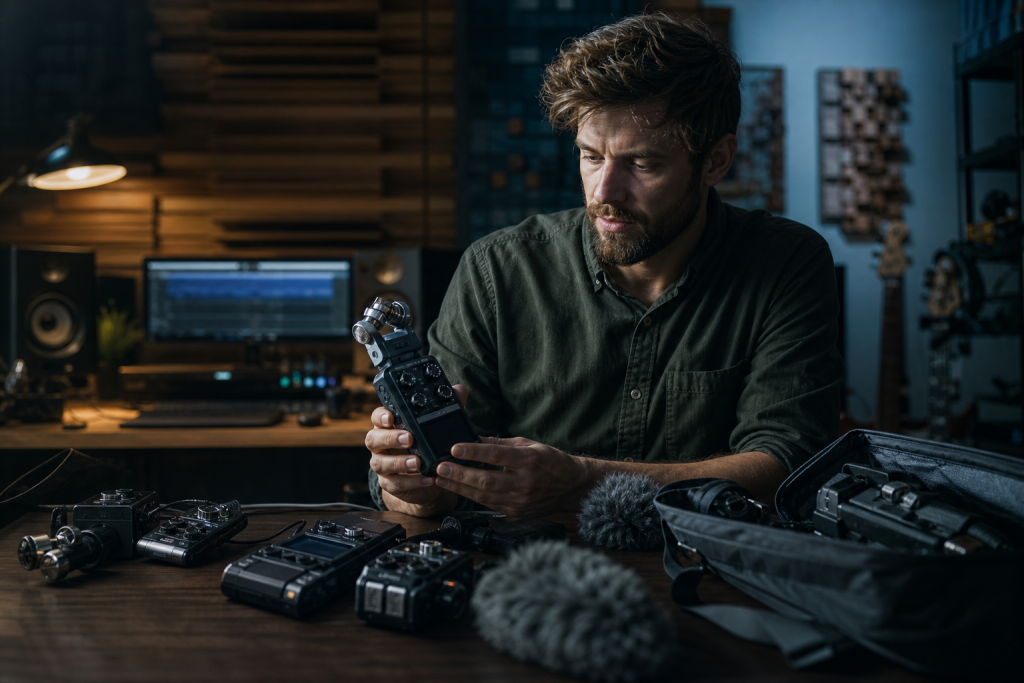
Packing for a two-week field trip is mostly an exercise in subtraction. Every cable, every battery, every windscreen has to justify the space it takes. And the one thing you cannot fix in post is bad sound, so the recorder is the last thing I’m willing to leave behind or cheap out on.
Below is what I’ve actually learned from running small recorders in conversations and in the open, plus the features that matter when you’re nowhere near a wall socket.
Two Jobs, Two Sets Of Priorities
Interviewing and nature recording look similar on paper. In practice, they pull the same hardware in opposite directions.
An interview rig lives and dies by its inputs. You want two XLR jacks minimum, clean gain for dynamic mics, and headphone monitoring that lets you catch a room tone change or a fussy jacket in real time. Battery life matters less because there’s often a plug nearby, but the ability to keep rolling through a ninety-minute conversation without touching anything matters enormously.
Nature recording is the opposite. You need long runtime, low self-noise, and enough storage for hours of ambience. Nobody is waiting on you. If the recorder whines or clocks in at a noisy floor, hours of dawn chorus are ruined.
What Actually Matters On Spec Sheets
Preamps and self-noise
The onboard preamps decide how much usable signal you get out of a quiet microphone. This is the single most common failure point on budget units. A cheap preamp with a high noise floor sounds fine on a loud voice and falls apart on a distant birdsong. If your plan includes quiet sources, spend here first.
Connectivity and battery
USB-C has become the default across the current crop of gear, which at least means one cable for everything, Mac and Windows included. Bus power over USB-C is now common enough that you can run whole sessions off a laptop, though I’d still carry a power bank for long days away from the grid.
Built-in batteries are the other half of the story. The Akai MPC Live III, for instance, carries a built-in battery that Akai rates at up to three hours, and in testing that figure was often met or exceeded. Treat manufacturer battery numbers as a ceiling rather than a promise, and always carry spare power for anything mission-critical. That little MP3 player you keep plugged in might have a terrible DAC, but it will keep going when everything else is dead.
Sample rate and bit depth
Most modern recorders record 24-bit up to 96kHz or 192kHz, and for most work 24-bit/48kHz is the sweet spot, giving clean quality with manageably sized files. Higher rates help for sound design or classical material, but they eat card space fast and rarely justify the trade when you’re tracking a conversation or a forest.
Storage and file safety
A recorder that writes to a single card with no redundancy is a smaller risk than it sounds, but only if you check the card before every session. Dual recording and auto-save recovery are the features that separate a serious field machine from a convenient one.
The Small Stuff That Bites You
- Touchscreens in gloves. Fine controls stay awkward on touch-heavy gear, and manual navigation is often faster. The Akai MPC Live III review notes that a navigation wheel and touch-sensitive encoders give a useful alternative to the screen, which is exactly the kind of redundancy you want when your hands are cold or wet.
- Wind. A foam windscreen does almost nothing outdoors. Budget for a proper blimp or deadcat before you leave.
- Headphone output. Two independent headphone outputs with separate gain control, as found on interfaces like the Antelope Audio Zen Go Synergy Core, are a genuine luxury on a dual-interview shoot.
- Onboard mics. Built-in mics are usually a fallback, not a solution. The MPC Live III’s built-in mic is described as useful rather than a replacement for a good mic, and that matches my experience with handheld rigs too.
Interviews Versus Ambience: What I’d Carry
For a sit-down interview, a compact two-input handheld with XLR is the workhorse. You get real mics, real monitoring, and files that drop straight into an editor. If the same unit has onboard storage and runs on AA cells, that’s one fewer charger in the bag.
For nature work, runtime and noise floor win. A single flexible capsule with a decent limiter and a long battery beats a feature-stuffed box that dies at hour two. Test the recorder’s noise floor with your quietest microphone before you commit to a location.
What I’d Skip
Anything marketed mainly on its speaker. Built-in speakers are useful for composing and jamming, and the MPC Live III’s are better than a stopgap, but you would not mix with them and they tell you nothing about a recording’s noise floor. On a field recorder, an onboard speaker is a luxury, not a reason to buy.
I’d also push back on chasing the highest sample rate on the box. If the preamps are average, 192kHz just gives you a bigger file of average sound. Fix the front end first.
The Verdict
Buy the recorder with the best preamps and the longest runtime, then make everything else a secondary question. For conversations, prioritise easy monitoring and two clean inputs. For ambience, prioritise low self-noise and storage. If a unit forces a compromise, compromise on sample rate and screen, never on the input path or the battery.