Room Treatment on a Budget: Quieter Recordings in Any Space
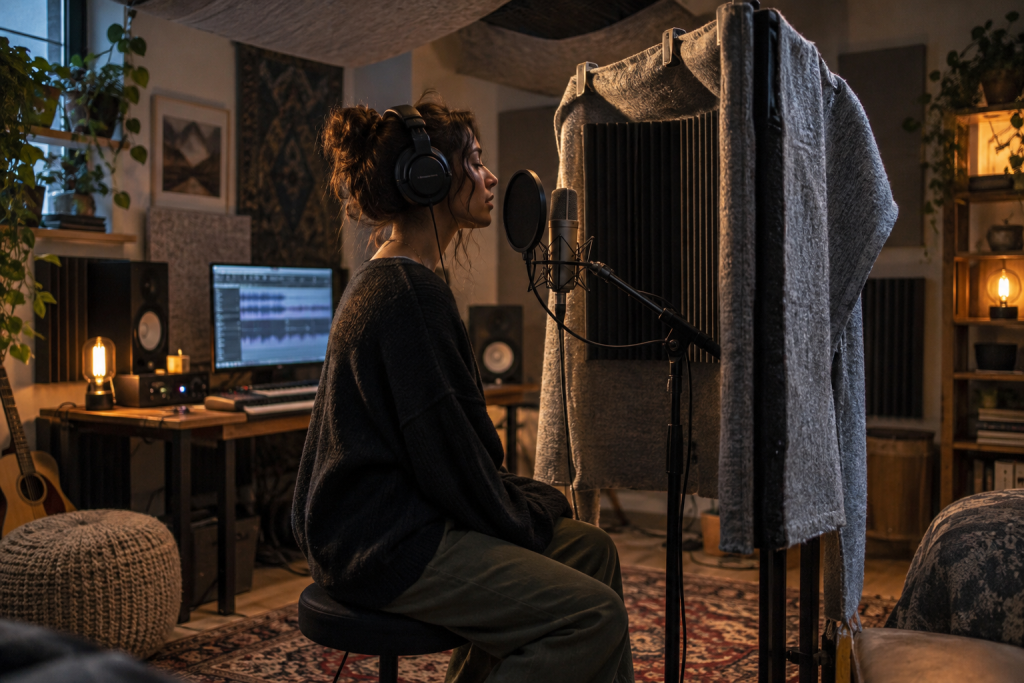
You can spend $800 on a microphone and still end up with a recording that sounds like it was tracked in a bathroom. I’ve watched it happen, and I’ve done it myself. The room is the variable most home recordists ignore, and it’s the one that shapes your raw sound the most after the microphone itself. Before you upgrade your interface or hunt for a new preamp, deal with the space. The good news: you don’t need a treated studio to get a quieter, cleaner take. You need to understand what the room is doing and attack the worst offenders first.
What Your Room Is Actually Doing to Your Recordings
Three problems show up in almost every untreated space: reflections, resonance, and background noise. They rarely announce themselves. Instead, you get a vocal that sounds boxy, a guitar that smears when you strum, or a track that just won’t sit still in the mix no matter how much EQ you throw at it.
Reflections are the biggest one. Your voice leaves your mouth, slaps off the nearest wall, and lands at the mic a few milliseconds late. That’s comb filtering, and it’s the reason a raw take can sound hollow or phasey.
Room resonance is the second problem. Small rectangular rooms have resonant modes, and they reinforce certain low frequencies while cancelling others. In a bedroom-sized space, that usually means a muddy buildup somewhere in the low mids that no amount of high-pass filtering fixes cleanly.
Background noise is the third. Fans, fridges, computer fans, traffic, HVAC. Your mic hears all of it, and it gets baked into the take where you can’t remove it without also removing part of the performance.
Here’s the ordering that matters: reflections first, resonance second, noise floor third. Most people buy foam and treat it as decoration. Do it in order instead.
The Free Fixes That Beat Most Foam Kits
Move the mic, not the room
The single biggest improvement in an untreated space is mic placement, and it costs nothing. Get the mic away from the wall behind it. If your condenser is 30cm from the back wall, the reflection off that wall arrives almost simultaneously with the direct sound and does the most damage. Pull the mic into the middle of the room and put the performer’s back to the longest dimension. You’ll lose some of the boxiness immediately.
You can also work the mic pattern. A cardioid pattern rejects more off-axis sound than an omni, and a tight dynamic rejects room reflections harder than a wide condenser. That’s exactly why a condenser in a treated space, a dynamic in an untreated one is the standard advice for home vocals: less room in the recording is usually worth more than more detail.
Use what you already own
Before you buy anything, raid your closet. A heavy blanket hung loosely behind the singer (not tight against the wall, leave an air gap) absorbs a surprising amount of mid and high energy. So does a mattress, a couch, a bookshelf packed with books, a full clothes rack. Soft, irregular, thick objects break up reflections better than a flat foam panel of the same size.
The trick is placement. Put absorption at the first reflection points: the wall behind the mic, the wall behind the performer, and the ceiling if you can. Corner stacks of soft stuff help with low-frequency buildup, but only if there’s enough depth. A thin blanket in a corner does almost nothing for bass.
Where Cheap Foam Goes Wrong
Let me be blunt about the acoustic foam market. Most thin foam tiles you see glued on bedroom walls do very little for the problems that actually hurt a recording. They’re too thin, they only work on high frequencies, and they leave the low-mid mud completely untouched. You end up with a room that sounds duller but not cleaner.
Worse, they’re often sold in “kits” that treat a fraction of the surface area you need. If you’re going to buy foam, buy thicker panels and cover more of the reflection points. If you’re not going to do that, don’t buy it. Spend the money on a decent dynamic mic instead and record in a tight pattern.
Rigid fiberglass or mineral wool panels, even the DIY kind, absorb across a much wider range and are the real move if you’re willing to hang something on a wall. Two or three well-placed panels beat an entire wall of decorative foam.
Measuring Instead of Guessing
This is where most budget advice stops, and it shouldn’t. You can actually see what your room is doing before you spend a dollar on treatment, using a free tool and a measurement mic.
Room EQ Wizard (REW) is a free room measurement tool with SPL, phase, distortion, RT60, clarity, decay, waterfall, and spectrogram views. It also does impulse response windowing and generates peaking-filter EQ for multiple platforms. You run a sweep through your speakers, read the decay and frequency response, and suddenly you know whether your problem is a ringing low end or a shelf of high-frequency reflections. That’s information you can’t get by ear in a normal room.
I’m not suggesting you try to EQ your room flat for recording. That’s a rabbit hole. But measuring tells you which problem to attack first, and it stops you from buying the wrong thing.
Where Digital Correction Fits, and Where It Doesn’t
Digital room correction is a real thing, and it’s worth understanding before you dismiss it or overtrust it.
Digital room correction applies filters designed to reduce the negative effects of a room’s acoustics on a sound reproduction system, and modern systems improve both time-domain and frequency-domain response. The process starts by measuring the room’s impulse response at a listening position, then a computer computes a FIR filter that attempts to invert the room and speaker effects. Digital correction systems can use acausal filters, and can operate with optimal time resolution, optimal frequency resolution, or a compromise along the Gabor limit.
That last point is the catch. You can’t have perfect time and frequency resolution at once. Every room correction system makes a trade-off, and most robust systems deliberately give up peak accuracy at the exact measurement point so the correction works over a usable volume and doesn’t produce artifacts elsewhere.
And here’s the part that matters most for recording: digital correction is about playback. AVRs, monitors, listening rooms. It’s not going to fix the reflections hitting your microphone during tracking. If you record in an untreated room and then listen through a corrected system, you’ve still got a bad take. Correction helps you hear it better. It doesn’t make it better.
Handling the Noise Floor
Once reflections are under control, deal with noise. This is the least glamorous part and the most underrated.
Turn off what you can. Air conditioning during a vocal take, the fridge if it’s on the same circuit, fans. If your computer fan is audible, move the machine into another room or behind a barrier. Cheap wins.
Beyond that, a dynamic mic with a tight pattern does a lot of noise rejection for you. So does getting the performer close to the mic, which raises the direct signal above the room and the noise floor at the same time. A pop filter at roughly 30cm from the mic, with input gain set so peaks stay below about -6dB, is a solid starting point that many home recordists overthink.
If you’re stuck with a noisy room, embrace it: record close, use a dynamic, and treat the space as a character choice rather than a defect.
What This Costs You
An honest budget version: move your mic and the performer for free. Hang what you already own for free. Buy a few thick rigid panels if you’re serious, and put them at first reflection points. If noise is your problem, buy a tighter dynamic rather than more foam.
The wrong version: hundreds of dollars on thin foam tiles that dull the highs and leave the mud. If you’re dropping cash, spend it on thickness and coverage, not decoration.
You can measure your room with REW and a USB measurement mic for the price of a couple of foam kits, and you’ll know exactly what you’re fighting. That’s the version I’d take every time. The room is the instrument you forgot you were playing, and it’s the one piece of gear you can improve without buying anything at all.