Microphone Polar Patterns Explained Without the Jargon
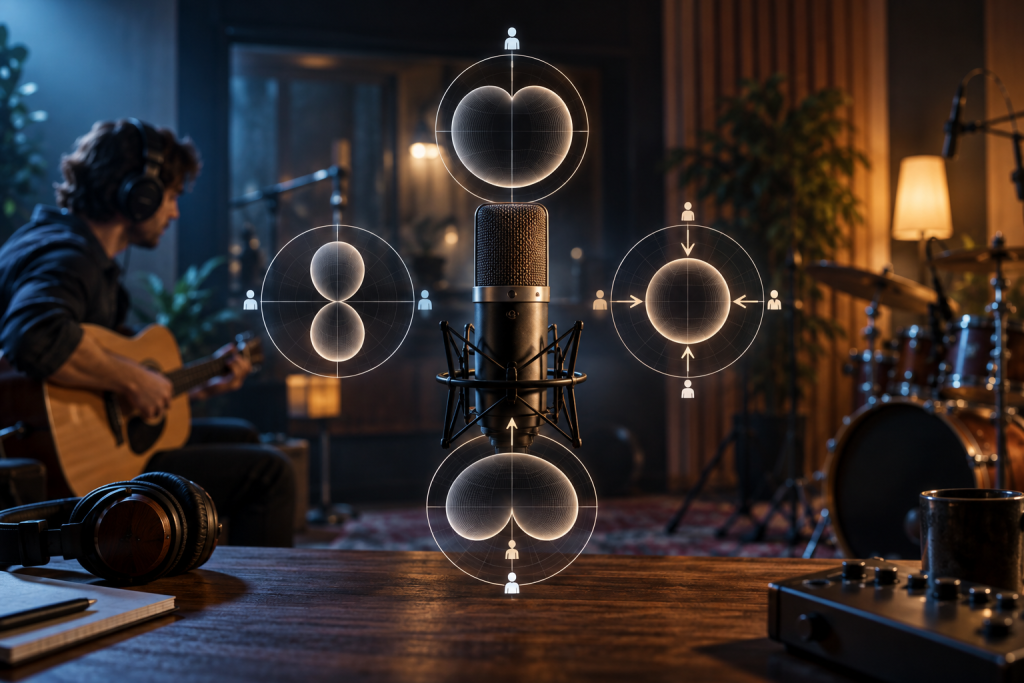
Every mic spec sheet has that little diagram at the bottom. A circle, a blob shape inside it, maybe two circles if the mic does something fancy. Most people glance at it, nod, and go back to reading about frequency response. That diagram is the polar pattern, and it tells you more about how a mic will behave in your room than almost anything else on the page.
If you record interviews, vocals, or ambient sound, understanding polar patterns is the difference between a usable take and one buried in room reflections. Here’s the practical version, no physics degree required.
What a polar pattern actually describes
A polar pattern shows how sensitive the microphone is to sound arriving from different directions. Imagine standing in the middle of that diagram with the mic capsule at your feet. The shape around you shows where the mic “hears” well and where it goes deaf.
That’s it. Directional sensitivity. Some mics hear equally in all directions. Some hear only what’s in front. Some hear front and back but reject the sides. Everything else is detail.
The four you’ll actually encounter
Cardioid
This is the default. The heart-shaped blob. Cardioid mics pick up sound mostly from the front and reject what’s behind them. That rear rejection is the whole point.
In sound reinforcement, cardioid is the standard pickup pattern precisely because it lets you point mics at performers while keeping them out of the main speakers, which cuts down on feedback (Wikipedia’s entry on audio feedback covers the directivity angle in depth). For recording, the benefit is simpler: less room in the take.
Here’s where it gets useful for home recordists. A dynamic mic with a tight cardioid pattern rejects room reflections far better than a wide-open condenser, which is why a dynamic in an untreated room often beats a condenser in the same space. Less room in the recording is usually worth more than more detail.
Omnidirectional
Picks up everything from every direction, equally. No rear rejection at all.
That sounds bad for isolation, and it is. But omni has real uses. A small omni placed in a good-sounding room captures the space itself, which is exactly what you want for nature recording or capturing a room’s natural reverb. In a bad room, an omni is a liability. It hears every reflection, every HVAC hum, every chair creak.
Some engineers love omni for its natural low-end response, since there’s no rear port causing proximity effect buildup. But for most home setups, it’s the wrong tool. Too much room.
Figure-of-eight (bidirectional)
Hears front and back, rejects the sides completely. Ribbon mics are typically figure-of-eight by design.
The side rejection is the interesting part. If you have two people facing each other across a table, a figure-of-eight mic between them picks up both voices while rejecting the noise to the left and right. That’s the classic interview setup, and it’s why ribbons show up in broadcast work historically.
The catch: figure-of-eight has strong proximity effect. Get close and the low end balloons. Back off and it’s manageable. It also picks up the room behind the subject, so placement matters.
Supercardioid and hypercardioid
Tighter versions of cardioid. More front focus, narrower pickup angle, but with a small rear lobe of sensitivity. That rear lobe means if you’re not careful, a monitor speaker behind the mic can feed back.
Shotgun mics are hypercardioid-ish, which is why they’re used for film and field work. You point them at the subject and get a narrow cone of attention. The tradeoff is off-axis coloration: sounds arriving from the sides get filtered and phase-shifted, which can sound odd if you’re recording music rather than dialogue.
Why this matters more than frequency response charts
Your room is the biggest variable in any recording. A polar pattern is your first line of defense against it.
Cardioid helps you get less room. Omni gives you all the room. Figure-of-eight gives you the room in front and behind but spares the sides. Supercardioid tightens the cone but adds a rear lobe you have to manage.
If you’re recording in a treated space, a condenser with a broader pattern is less of a problem. If you’re in a bedroom with bare walls, a dynamic cardioid is your friend. That’s the practical split: condenser in a treated space, dynamic in an untreated one.
This isn’t just theory. When you’re comparing 5 to 6 mics, you want variety in character, and polar pattern is a huge part of that character. A condenser, a dynamic, a ribbon: those three already give you different patterns and different room sensitivity before you even get to tone.
How to test polar patterns yourself
The fastest way to understand a pattern is to walk around the mic while someone talks. Put on headphones, set the gain properly (peaks under -6dB), and have a friend speak a consistent phrase. Move from directly in front to 90 degrees off-axis to directly behind.
You’ll hear the tone change. Cardioid gets darker and quieter off-axis. Omni stays consistent. Figure-of-eight drops out at the sides entirely. That experience sticks in a way a diagram never will.
Then record the same phrase from 30cm directly in front on each of your candidate mics. Same position, same preamp, same performance. Listen for how much room is in each take. That’s the polar pattern at work.
Patterns and multi-pattern mics
Many large-diaphragm condensers let you switch between cardioid, omni, and figure-of-eight. This is genuinely useful. One mic that does all three is worth considering if you record different sources in different rooms.
But don’t let the switch sell you on a mic that doesn’t sound good in cardioid. The pattern is a tool, not a feature list entry. A great cardioid-only mic beats a mediocre three-pattern mic for most vocal work.
Quick reference
- Cardioid: Front pickup, rear rejection. Default for vocals and live sound.
- Omni: Everything equally. Great room capture, terrible isolation.
- Figure-of-eight: Front and back, side rejection. Interview and ribbon territory.
- Supercardioid/hypercardioid: Tight front focus, small rear lobe. Shotguns and field work.
Next time you’re shortlisting mics, check the pattern first. If you’re in a less-than-ideal room, a cardioid dynamic will serve you better than a fancy condenser that hears every reflection in the room. Get the pattern right before you worry about anything else.