Capturing Ambience: How to Record the Sound of a Place
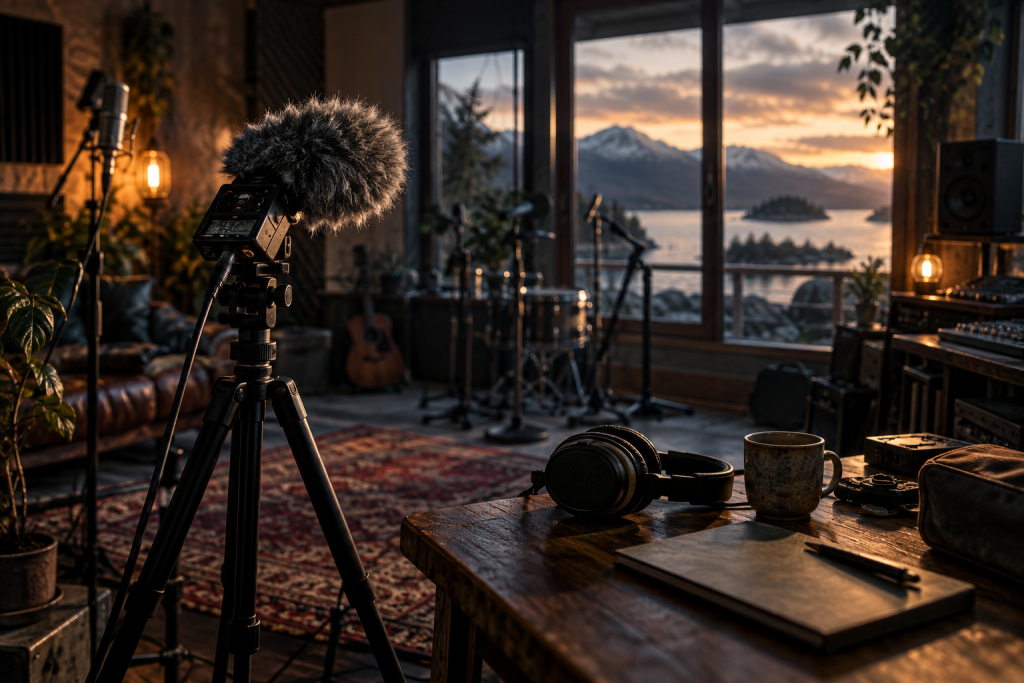
The best ambience I ever captured cost nothing and took four minutes. I was standing in a stairwell of an old hospital building, holding a Zoom H4N, waiting for a friend to finish a coffee. The building was empty. I hit record and just let the room sit there for a while. No wind. No traffic bleed. Just the slow exhale of a concrete shaft that had been holding sound since the 1950s.
That recording has ended up under three different projects. A podcast intro. A short film scene. A ghost cue for a horror thing that never got made. None of it came from a library. It came from standing in the right place and shutting up long enough to let the space speak.
If you have ever stood in a stairwell and thought “this should be in a track,” you already know what this article is about. That feeling is the whole point. It’s just a question of respecting it enough to record it properly.
Ambience is not reverb (but they are cousins)
Reverb, at least in the acoustic sense, is the persistence of sound after the source stops. It’s built from reflections bouncing off walls, ceilings, people, air. Frequency dependent, meaning the high end dies quicker and the low end hangs around like a guest who won’t leave.
That’s Wikipedia’s definition and it holds up. What matters for recording is that reverb is part of ambience, not the whole thing. Ambience is the room plus everything in it: the hum of a fridge two rooms over, a car passing somewhere below, a bird doing bird things. Reverb is the tail. Ambience is the whole body.
When you record a place, you’re capturing both at once. That’s why you can’t fake it convincingly with a plugin. Convolution reverb gets you the reflections. It doesn’t get you the neighbour’s dog.
Start with a bad recorder
Here’s a thing that surprised me when I first heard it. Nick Peck, who has been the audio director on Star Wars projects since 1998, including Battlefront, abandoned high-end field recorders in favour of a Zoom H4N. According to him, no loss in results.
That’s worth sitting with. Because the instinct, when you start getting serious about field recording, is to buy your way toward quality. A Sound Devices. A pair of Schoeps with a blimp. And there’s nothing wrong with that gear. But if you can’t hear the room yet, the gear won’t teach you. A $200 handheld will.
What the good recorders get you is low self-noise and better preamps. That matters for quiet sources like distant birds or a clock ticking. It matters much less for room tone, which is by definition not that quiet. My advice: record with what you have until the recorder is the thing limiting you. For most people, that’s never.
I still use a handheld on most trips. It’s the one I don’t worry about. That matters more than the spec sheet.
What you actually point the mic at
Ambience, in the recording sense, means the sound of the space rather than the sound of the source. You’re not trying to capture the drummer. You’re trying to capture the room the drummer is playing in.
The classic version of this is gated reverb on drums, which is a whole different beast. You set up close mics on the kit and ambience mics further back to catch the early reflections. You feed the ambience mics through a gate, keyed off the close mics, so the ambience only opens for half a second after each hit. The result is a drum that sounds like it’s in a huge live room without the mess of secondary reflections.
Note what’s happening there. The ambience mic is doing the emotional work. The close mic is just telling the gate when to listen. That’s the hierarchy you want when recording a place too. The close thing is the trigger. The far thing is the point.
So when you’re recording ambience, don’t just stand in the middle of the space. Walk around it. Put the mic where the reflections are strongest. Near the wall, not centre. Facing the corner, not the door. The mic is not hearing what you’re hearing. It’s hearing what’s bouncing off the surfaces.
How long to record, and why longer
Most people record way too little. Thirty seconds feels like a lifetime when you’re standing still. It’s nothing. Room tone needs time to reveal its layers: the traffic cycle outside, the ventilation rhythm, the way a fridge kicks on and off.
I record five minutes minimum. Ten if the space is interesting. Ten if I might never come back. Because you cannot loop a two-second room tone without hearing the loop. The ear catches it on the third pass. Five minutes gives you enough variation to build a bed that actually breathes.
Reverberation time, by the way, is the thing you’re really sampling here. Bigger room, harder surfaces, longer tail. Speech in a long-reverb space gets muddy fast, which is why lecture halls and podcast booths are built differently. If you’re recording ambience for use under dialogue, remember that whatever you capture will compete with the voice. A cathedral is beautiful and unusable for that.
The processing is where it gets fun
Peck, on a horror project, recorded six or seven friends whispering in a circle during an Academy Awards party. Then he ran those recordings through reverse reverb and delays to build ghost ambiences from nothing.
Read that again. The raw material was a living room full of people at a party. The distinctive part was the processing and the crowd. That’s the whole lesson of his approach, and it shows up elsewhere in the interview: creative decisions made under constraint tend to beat reaching for a premium library or a complex chain.
So don’t think of field recording as picking up ready-made sounds. Think of it as mining raw material. A stairwell hum recorded at 6 a.m. can become a pad. A train station recorded from across the street can become the bottom of a synth patch. Whispering friends can become ghosts with the right reverb and a tape delay.
The prep matters less than the ears. That’s not a motivational poster. It’s just that the person who knows what they’re listening for will get more out of a $200 recorder than the person who bought the expensive one and doesn’t walk around.
Practical habits that pay off
- Record the silence before you need it. Ten minutes of room tone in every space you visit. You will not regret this. You will regret not having it.
- Note the time and weather. A room at 6 a.m. and a room at 6 p.m. are two different rooms. Traffic, people, HVAC cycles, birdsong all change with the clock.
- Get close for detail, far for space. Same space, two passes, one mic pointed at the source of a small sound and one pointed at the reflections off the wall. You’ll use both.
- Wear headphones, monitor quietly. You’re listening for things the room is doing, not for how loud it is. Closed-back cans keep the leakage down.
- Don’t edit on site. You’ll hear things later that you missed in the moment. Give yourself options.
One more thing about time. Field recording is the only audio discipline where the recorder is actively working against you being in a hurry. You cannot rush a room tone. You just have to stand there with the mic pointed somewhere thoughtful and trust that patience is a technical skill.
It is. Just an unpopular one.
Where it all ends up
The boundary between music and audio post is more porous than most people in either camp admit. Peck has run both threads his whole career, a serious synth practice anchored by a Minimoog he’s owned for decades, alongside his picture sound work. He argues that keeping music alive in the middle of sound design is the thing that holds the practice together.
You don’t need his résumé to feel that. You just need to record a stairwell on a Wednesday afternoon, take it home, pitch it down an octave, throw it under a pad, and hear the space turn into something else entirely. That’s the loop. Record the place. Process the place. Let the place become the sound.
The gear is not the point. The time in the room is.