How Loud Should Your Podcast Be? A Simple LUFS Guide
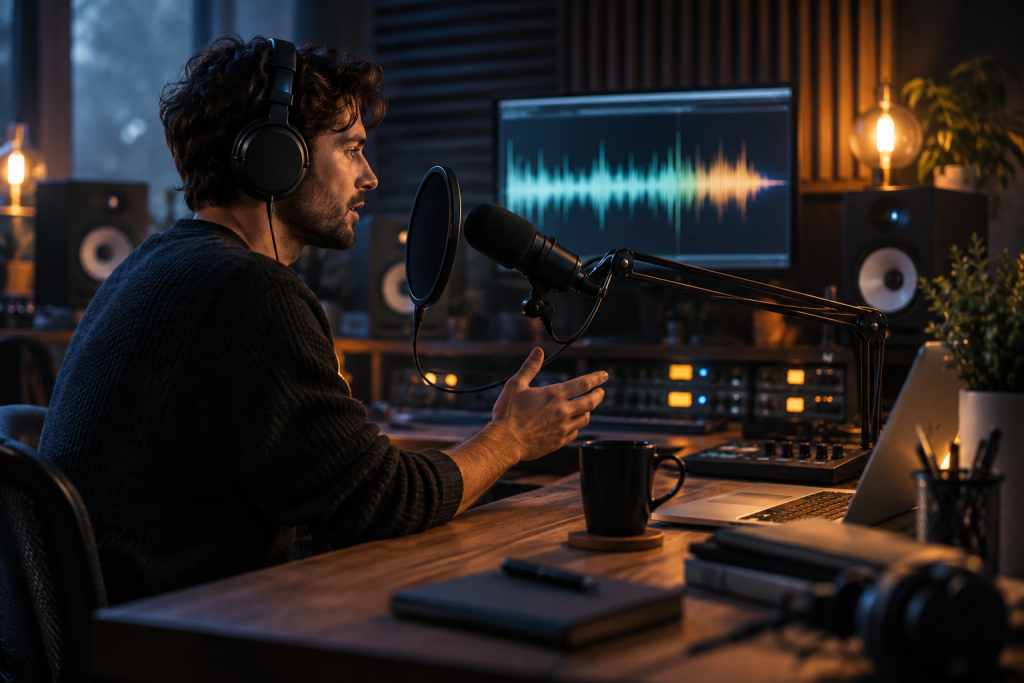
Somewhere between uploading and publishing, half the podcasts in my feed get squashed flat by a limiter set to “as loud as possible.” You can hear it: cymbals fizzing, plosives crackling, the whole thing exhausting after ten minutes. The fix isn’t a magic plugin. It’s a number, and it’s probably smaller than you think.
What LUFS actually measures (and why your DAW’s peak meter lies to you)
LUFS stands for Loudness Units Full Scale. It’s a loudness measurement that tries to approximate how human ears perceive level, not just how much signal is hitting the ceiling. A peak meter tells you the loudest instant in your file. An LUFS meter tells you the average perceived loudness across a window of time, typically three seconds for the “integrated” reading.
That distinction matters because two files can have identical peaks and completely different perceived loudness. A podcast with a compressed, dense voice track and a podcast with a wide dynamic range interview can both peak at -1 dBFS. One will sound twice as loud in headphones.
I keep a meter on my master bus at all times. Youlean Loudness Meter is the free choice here. It measures in LUFS, which is the standard streaming platforms and broadcasters actually use, and it shows you where you sit relative to platform targets. Clean interface, accurate, free. If you’re mastering anything, even just for your own podcast, you should be looking at it. (Source: borntoproduce.com)
The numbers you actually need
So what’s the target? It depends on where your audio is going. Broadcasters and streaming platforms have settled on a range of standardized levels, and they’re not all the same. (Source: Wikipedia, Audio normalization)
- -14 LUFS: Spotify, Tidal, YouTube, TikTok
- -19 to -16 LUFS: PRX podcasts
- -24 LUFS: NPRSS and PRX radio broadcast, ATSC A/85 (US TV)
- -23 LUFS: EBU R 128 (European broadcast)
- -27 to -24 LUFS: Netflix, Disney+, Prime Video
Look at that podcast line. PRX podcasts sit between -19 and -16 LUFS. Not -14. Not -9. If you’re mastering a spoken-word show and you’re hitting -10, you’re six to nine units hotter than the reference. That’s the difference between a comfortable listen and a fatiguing one.
Spotify’s -14 is a normalization target, not a mandate. The platform turns loud tracks down and quiet tracks up to hit that number. So if you deliver at -14, you play back at roughly what you submitted. If you deliver at -9, Spotify pulls you down. If you deliver at -20, Spotify pushes you up, and might push up your noise floor with it.
Why louder isn’t better, and where the loudness wars went
There’s a whole generation of music masters sitting around -8 LUFS, mostly pop, and that’s a genre choice. For a three-minute chorus-driven song, that works. For a forty-minute two-person conversation, it’s a brick. (Source: majormixing.com)
Here’s the thing that changed: streaming normalization made loudness wars partly pointless. Push your master to -8 and Spotify turns it down to -14 anyway. You’ve just paid for the limiter artifacts and lost the dynamics. Gone are the days of slapping a limiter on and cranking until it hurts. You want a master that sounds loud and stays dynamic. (Source: mastering.com)
That’s especially true for podcasting, where the content is voice. Voice is the most dynamic thing in your whole production. If you crush it, you flatten the emotional range of every sentence. The “she’s excited” and “he’s thinking” moments both end up at the same level. Your listener stops caring.
A working target for most podcasts
If you’re producing a spoken-word show for general distribution, aim for -16 LUFS integrated with true peaks around -1 dBTP. That sits right in the PRX podcast range, gives you headroom for music beds, and plays back at roughly the same perceived level as other podcasts your listener already subscribes to.
If you also publish a music-heavy segment or you’re also putting the show on YouTube, -14 LUFS is fine. Pick one and stay consistent across episodes. Consistency beats numerical perfection. A listener doesn’t compare your show to a Spotify standard. They compare episode three to episode four.
For interview shows with wide dynamic range, or anything with a field recording element, err toward -18. You need the room.
The workflow I actually use
Signal chain matters more than the final number. If you’re trying to hit -16 with a single aggressive limiter at the end, you’ll hear it. The cleaner path is to do most of the loudness work earlier.
Voice compression first. Gentle, consistent, doing its job across the whole episode. Then a limiter for peaks. Aim for around 3 to 4 dB of gain reduction at the limiter. Pay attention to what the limiting does to your transients and diction. If consonants start disappearing, you’ve gone too far. Use true peak limiting so inter-sample peaks don’t clip on consumer playback systems. (Source: recordmixandmaster.com)
If you find you need more than 4 dB of limiting to reach your target, the problem isn’t the limiter. It’s the levels upstream. Go back.
Some engineers run two limiters in series, each doing a smaller amount of work. It can be more transparent than one limiter doing all of it. Worth trying if a single stage is sounding thick.
Measure, don’t guess
The single most useful habit is to load reference podcasts into your session and meter them. Not to copy their sound. To see their numbers. Pick two or three shows in your genre that you genuinely like the sound of, drop them into your DAW, and read their integrated LUFS. You’ll learn more in ten minutes than from any target chart. (Source: recordmixandmaster.com)
Then meter your own. Iterate. The meter shows you what’s happening, and you make the calls. That’s the whole loop.
One thing worth repeating: loudness normalization on streaming can require dynamic range compression to prevent clipping when content gets pushed up, which alters signal-to-noise ratio and relative dynamics. (Source: Wikipedia, Audio normalization) Translation: if your podcast is quiet and noisy, normalization can drag the noise up with it. Better to deliver at the right level than to rely on the platform to fix it.
What to do this week
Install Youlean Loudness Meter or any accurate LUFS meter. Free is fine. Meter your last published episode. Compare it to the PRX podcast range of -19 to -16 LUFS.
If you’re hotter than -16, you’re probably crushing your voice. If you’re under -20, your listeners are turning the volume up and hearing your room. Find the middle. Set your limiter so it’s doing 3 to 4 dB of work, not 8. Aim for consistency across episodes over any single number.
The podcast sounds better when the person talking sounds like a person talking. That’s the whole point.