The Art of the Audio Story: Structuring Sound That Holds Attention
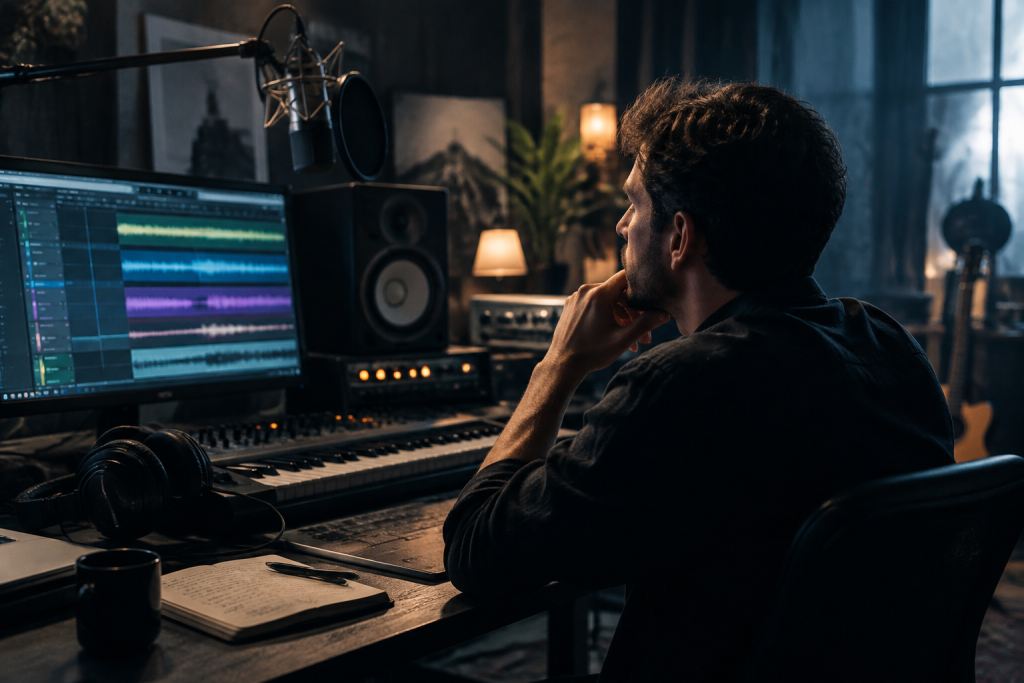
The best audio stories are not written. They are built. And the building almost always happens in the edit, long after the recording session ends, when you start deciding what the listener hears first, what they hear last, and what they never hear at all.
I keep coming back to a conversation with sound designer Nick Peck, who has worked on Star Wars projects since 1998, including a stint as Audio Director on Star Wars Battlefront. For an unannounced horror project, he needed ghost ambiences and did not reach for a premium library. He recorded six or seven friends whispering in a circle at an Academy Awards party. Then he processed those takes with reverse reverb and delay.
That is structuring sound under constraint. And it is the same muscle you use when you decide a podcast episode’s cold open should be a half-second of room tone instead of a music sting.
Attention is a budget, not a switch
Your listener gives you about 10 to 15 seconds before they decide whether to stay. That number comes from the music side, but it applies to audio narrative just as hard. A podcast intro that spends 40 seconds on housekeeping has already spent the budget.
Short-form thinking helps here. A tight 2:30 piece that gets replayed beats a 4:00 piece played once. That is a royalties argument in music, but the underlying truth transfers: replays mean the thing earned its length. If your episode’s middle third is there because you recorded it, not because it moves, cut it.
This does not mean everything gets shorter. It means every section earns its place. A 45-minute interview with a great subject can feel like 20 minutes. A 12-minute piece with three redundant setup beats feels like an hour.
Structure is arrangement
Producers already know how to think in layers. A pad holding the chord. A lead up top. A rhythmic element panned wide. A centered voice with a subtle delay tail. A sub gluing it down.
Audio storytelling is the same architecture with different nouns. Narration is your centered voice. Ambience is the pad. Sound effects are the rhythmic hits. Music is the glue or the counterweight. When you solo each element and ask whether it serves a unique role, you find the clashing pieces fast.
Two elements fighting for the same job is the most common structural failure I hear in indie podcasts. Narration explaining what the ambience already told you. Music pushing emotion while the interview subject is already delivering it. Pick one. Give the other a different job or mute it.
Tension and release, in sound
Great music plays with expectation. You build a moment of tension, then resolve it. Same principle in audio narrative.
Ways to build tension in a sound story:
- Introduce a question the listener wants answered, then delay the answer
- Drop the music out entirely for a few seconds
- Bring in a low-frequency bed that slowly rises under speech
- Use a sound effect that repeats and slightly shifts each time
- Cut a beat earlier than expected, then hold silence
Tension does not mean chaos. It means creating space for something satisfying to arrive. A horror ambience built from reversed whispers works because it withholds: you register voices before you register words. That withholding is the structure.
Constraint beats the premium library
Here is where I will get argumentative. Plenty of sound designers treat field recording gear as a proxy for quality. Peck abandoned high-end recorders for a Zoom H4N with no loss in results. What mattered was where he pointed it and what he did with the files.
The same applies to your plugin folder. A living room full of friends whispering produces more distinctive audio than a complex signal chain on a stock effect. Not because the chain is bad, but because the source carries specificity you cannot synthesize.
Hardware people will recognize this from the other direction. Vintage gear has flaws: oscillator instability, thermal drift, behavior that shifts with voltage. Those are technically problems. In practice they introduce variation and surprise, and they break the too-smooth perfection software can fall into. Software usually seeks perfect reproducibility. Hardware accepts uncertainty.
Structure benefits from that uncertainty. If every take is identical, every take is interchangeable, and interchangeability is the enemy of narrative.
What processing can and cannot rescue
I want to be blunt about this because I see it wasted constantly. Mastering is finishing. It will make a track loud, compliant, and tonally balanced. Every structural problem in the arrangement will still be there, now easier to hear.
Randomizing timing on a part that was never played with intention does not create human feel. It creates sloppiness. Micro-timing reads as human when it correlates with the phrase: ahead because the phrase pushes, behind because it relaxes. Random offsets correlate with nothing.
Sound design for narrative obeys the same rule. Adding a reverb tail to a transition that has no reason to be there does not fix the transition. It decorates a mistake.
Respecting an established vocabulary
If you are working inside an existing sonic world, whether a franchise, a branded show, or a series with a recognizable identity, treating the established vocabulary as a discipline rather than a constraint changes how you work. You are not free-associating. You are composing inside a key.
This is also why the boundary between music and audio post is more porous than either community admits. Peck has sustained a serious synthesizer practice anchored by a Minimoog he has owned for decades alongside a full career in picture sound. The two feed each other. Keeping music alive inside post work sharpens the ear you use for structure.
A practical order of operations
When I structure a piece, I work in this order most of the time:
- Spine first. Lay the narration or central voice only. No music, no effects. If it does not hold attention bare, nothing you add will save it.
- Mark the turns. Where does the piece change direction? Those are your structural joints.
- Ambience second. Place room tone and beds. They establish place and give the ear something to sit on.
- Effects third, as punctuation. A sound effect at a structural turn does more work than ten scattered through a scene.
- Music last. Add it where the piece is missing something, not everywhere it fits.
- Then cut. The first pass is always long. Remove 10 to 20 percent and see what survives.
That last step is the one people skip. The edit is where the story actually gets written.
The mix is part of the structure
Dynamics are not a finishing touch. Loudness decisions shape attention. Push too hard and you flatten the piece into a fatiguing wall. Let it breathe and quiet moments carry weight.
Saturation and stereo work sit in the same category: subtle enhancements that make a piece feel finished, and both need care. Stereo widening done carelessly creates phase problems that collapse in mono, which is how a lot of listeners will hear it.
If you are mixing for a streaming platform or a podcast app, get the target loudness right early. It is a structural decision, not a checkbox at the end.
Where to start this week
Take one short piece you have already made. Solo the elements. Ask what each one does. Find the two fighting for the same job and mute one. Then listen to the whole thing next to a piece you admire in the same genre.
The gap you hear is almost never the gear. It is the structure.