Foley 101: Making Everyday Sounds for Story and Film
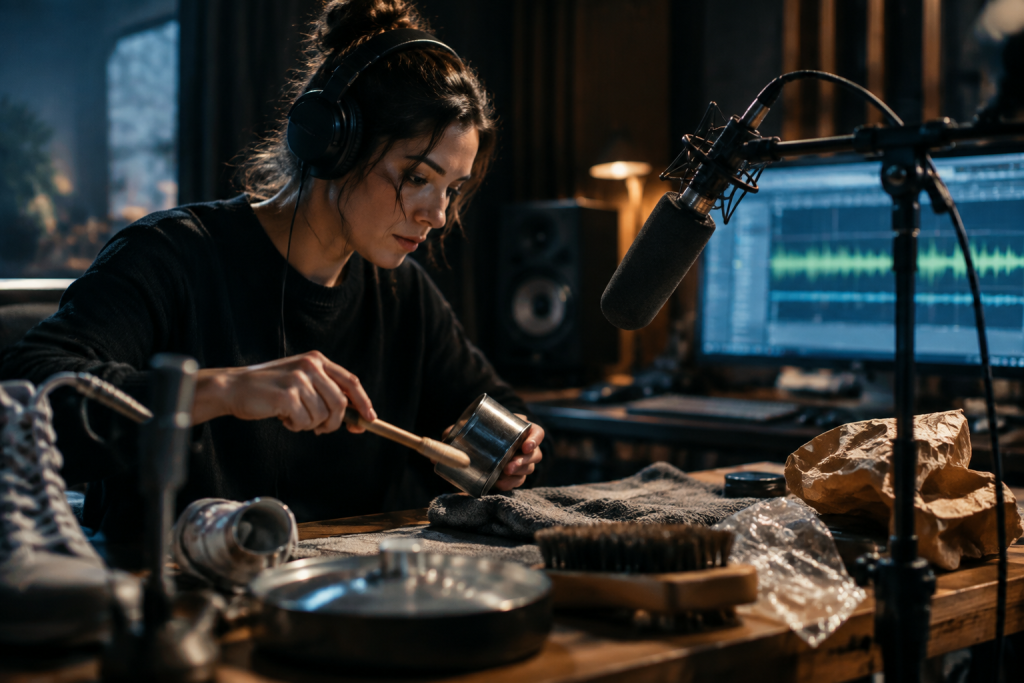
The first time I watched a Foley artist work, I couldn’t stop staring at the shoes. Not the actor’s shoes on screen. The pile of shoes off-camera. Half a dozen pairs, all different soles, laid out like a percussion kit next to a pit of gravel, a wooden door, and a bag of cornstarch. Every step a character took on screen got rebuilt live, by hand, on the spot.
That’s the whole discipline in one image. Foley is the art of performing everyday sound in sync with picture, and it has almost nothing to do with the gear you own. It has everything to do with what you can find in a kitchen, a closet, or a parking lot.
What Foley actually is (and what it isn’t)
Most people use “Foley” as a catch-all for any sound effect. It’s more specific than that. Foley is performed sound recorded to picture in real time. Footsteps, cloth movement, the clink of a cup set on a table, hands patting a jacket. These are small, human sounds that the audience doesn’t consciously hear but absolutely notices when they’re missing or wrong.
What it isn’t: explosions, car chases, laser blasts. Those live in the sound effects library or in the synthesizer. The Wikipedia entry on sound design draws the line plainly, noting that sound design commonly involves performing (see, e.g., Foley) and editing of previously composed or recorded audio such as sound effects and dialogue. Foley is the performance half.
The reason producers rebuild footsteps at all, instead of just boosting the production audio, is control. On location, a boom mic picks up the dialogue but also the air conditioning, the traffic, and the crew’s shoes. By the time you’ve cleaned that track up, the footsteps are gone. So you make new ones.
The room you already have
Nick Peck, who has worked on hundreds of Star Wars projects since 1998 and served as Audio Director on Star Wars Battlefront, told Bobby Owsinski’s podcast that he abandoned high-end recorders in favor of a Zoom H4N with no loss in results. That’s worth sitting with. The recorder was never the bottleneck.
Your room and your props matter far more than your preamp. Here’s a rough kit that costs almost nothing:
- Shoes. Sneakers, hard leather soles, boots, and a bare foot. A pair of dress shoes on gravel reads as a different character than the same shoes on tile.
- Cloth. An old jacket, a towel, a canvas bag. Grab the fabric and move it near the mic to place a character’s body in the scene.
- Hard objects. A ceramic mug, a glass, a metal spoon. These make the signature sounds of a scene without you ever touching the actor’s actual prop.
- Cornstarch or sand. Poured into a tray, it’s snow, rain, or the crunch of a gravel path.
- A door with a real latch. No plugin does a convincing front door.
Set up on a hard floor or a piece of plywood. You want the option of a reflective surface for footsteps that need to sound like a hallway, and a rug for a carpeted room.
Gear: keep it boring
For recording, a small shotgun or cardioid condenser on a boom stand aimed at your props will do. A Zoom H4N or similar handheld is fine as a recorder. What you want is a low noise floor and a close placement, because Foley is a close-up art. You’re not recording a room. You’re recording a shoe.
If you’re choosing a mic for the job, the same logic that applies to vocal mics applies here: contrast matters more than brand.
- A condenser for clean, detailed cloth and small objects.
- A dynamic for rugged, high-SPL hits like a door slam or a punch.
- A ribbon if you want a darker, vintage character on footsteps.
You don’t need all three. Pick the one that matches the scene you’re doing most, and move the mic closer or further instead of swapping it.
Performing to picture
This is where Foley gets hard, and where the payoff lives. You’re not recording a sound. You’re recording a sound at the exact moment the character makes it.
The workflow I settled into: loop the clip, watch it ten times without recording, then record. Watch how the actor’s heel lands. Is it a full plant or a toe-first step? Does the cloth rustle on the turn or the sit? The performance is the sync.
Then you record three or four takes and pick the best. Nobody nails a stride on take one. Foley artists often work in a loop, recording the same action over and over until the timing sits. If you’re doing this alone, a metronome count-in before the clip starts helps you land the first step.
When to reach for a synth instead
Not every sound has a real-world source. If you’re building a creature, a ghost, or a machine, the performance approach breaks down. That’s where processing and synthesis come in, and it’s a legitimately separate skill.
Tools like Digital Brain’s Voxpat, for instance, are built around convolution effects, pitch shifters, and a sample player that can follow incoming audio. The plugin’s own designer noted that because the effects run in parallel, many settings don’t sound like a single voice but like multiple voices or a chorus, which is great for a monster and wrong for realism. Pitch shifting, in that plugin, tends to work for supernatural or alien creatures rather than humans.
Peck’s approach to ghosts was simpler and, to my ear, smarter. For a horror project, he recorded six or seven friends whispering in a circle during an Academy Awards gathering, then processed those recordings with reverse reverb and delays to build ghost ambiences from scratch. No premium library. Just a room full of people and a willingness to try.
That’s the recurring lesson from working sound designers. Constraint produces character. A living room of friends beats a $300 sample pack when you need something specific and strange.
Where Foley and music blur
One thing worth stealing from Peck’s practice: the boundary between music and audio post is more porous than either community admits. He’s kept a serious synthesizer practice for decades, anchored by a Minimoog, alongside a full career in picture sound.
That crossover shows up in Foley too. A footstep recorded on the right surface is a percussion hit. A cloth rustle, pitched down, is a texture pad. If you’re building both the music and the sound for a piece, treat them as one palette. The reason hardware synths still earn their place, as one AudioFanzine piece put it, is that the commitment to a take forces a decision you can’t endlessly revise in the DAW. Foley has the same discipline built in. You either performed the step or you didn’t.
A first session you can actually run
Pick a 20-second scene with one character walking and sitting down. Mute the production audio except for dialogue. Lay out shoes, a jacket, and a chair. Record footsteps in a loop, three takes. Then record the sit: the cloth rustle, the chair creak, the exhale. Cut it together and listen back with headphones.
You’ll learn more in that hour than from any tutorial. The sound of a shoe on your floor is the sound of a character in a place. That’s the whole job. Get the everyday sounds right and the audience never thinks about you. They just believe the room.