Recording a Podcast Interview in a Cafe Without It Sounding Like a Cafe
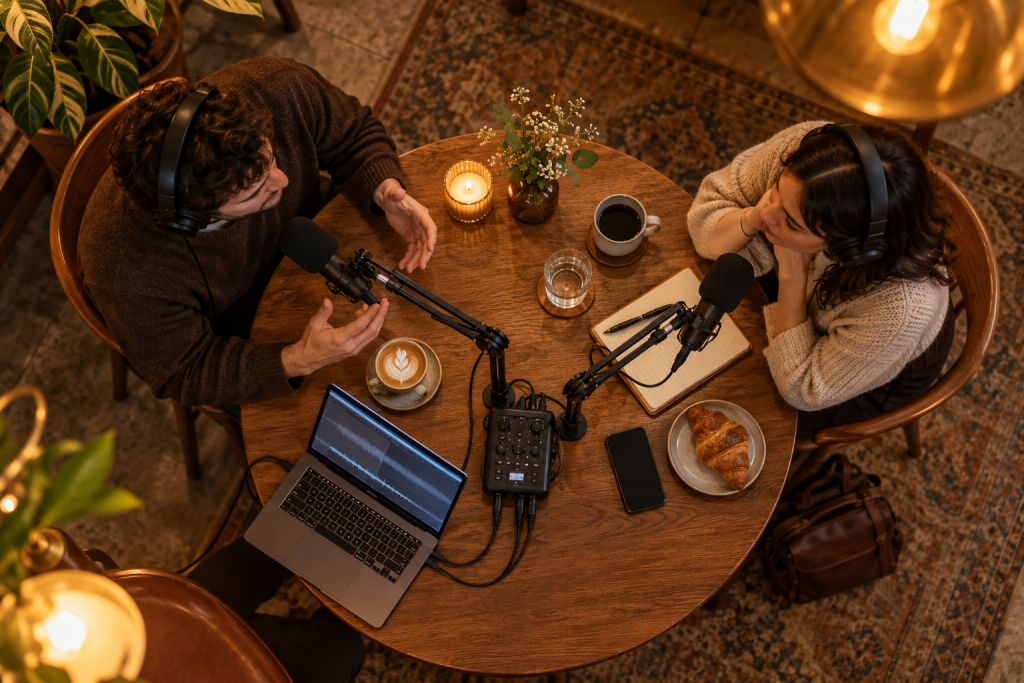
You know that moment when you get back from a cafe shoot, pull the file into the editor, hit play, and the espresso machine hisses back at you like it’s the co-host. The conversation was good. The recording is barely usable. It’s a small tragedy, because the whole appeal of recording a podcast in a cafe is the atmosphere. You want the energy of a real room. You just don’t want the barista, the blender, and the guy on speakerphone showing up in the waveform.
You can fix most of this. Some of it is gear, most of it is how you sit and where you point things. Let me walk you through the way I actually handle these sessions now, because the first time I tried it I ended up with an unusable 40-minute recording and a lot of regret.
Where you sit matters more than what you buy
Before you choose a mic, look at the room. Cafes have two useful zones: the quieter corners with soft edges, and everything else. A booth against a wall with some curtains or an upholstered banquette is the only kind of seat that gives you any help. If the seat is a hard table in the middle of an open floor, no amount of gear is saving the session.
You’re scanning for three things: soft surfaces close to the mouths, distance from the espresso machine and the door where people cross and chat, and a wall behind you that isn’t a mirror or bare plaster. A corner gives you extra density of reflections, which can work against you if you’re close to it. So sit slightly out from the corner, not in it.
Choose a microphone that ignores distance
This is the single biggest lever you have, and it’s counterintuitive for people who mostly record at home. The instinct is to bring the cleanest, most detailed condenser you own. In a cafe, that mic will pick up the table next to you, the kitchen, and the room at large. Detail is not your friend here.
What helps is pattern and proximity. A dynamic mic or a tight cardioid condenser handled close to the mouth is what keeps the room out of your recording. Build contrast into your shortlist rather than buying five versions of the same thing: one clean condenser, one dynamic, and a darker option to compare. Testing five or six mics with the same spoken phrase for a minute each will tell you more than any spec sheet (as the Major Mixing guide puts it, contrast matters more than having “options”).
My default for two-person cafe recordings is a dynamic handheld or a supercardioid mic with a foam windshield, positioned about a hand’s width from the mouth. Yes, it looks a little aggressive. Nobody in a cafe cares. The takes come back clean.
The close-mic trick that sounds too obvious
Every inch of distance adds room to the recording. Getting the capsule from 30cm to 10cm changes the balance more than any plugin later. With close micing, you need low input gain because the voice is loud at the capsule, and that keeps the ambient noise floor down too. A pop filter or foam shield handles plosives at that distance.
If you’re recording two people, two cardioid mics angled away from each other (“crossed” or very slightly apart) reject each other’s voice better than one shared mic. Two close mics beat one expensive mic on a table every time.
The untreated cafe can be tamed with a few moves
You can’t build a vocal booth in the cafe. You can carry a folded blanket or a thick scarf in the bag, drape it on the table edge facing you, and it eats some of the reflections off the hard surface. It’s ugly. It works. I did this for a documentary interview last year and it made a measurable difference on the raw file.
A couple more physical habits:
- Face your co-host, don’t face the room. Your bodies absorb some of the reflections coming off the far wall.
- Turn off the phone’s ringer, and set it face down. Vibration on a table is a recording hazard.
- Ask the staff, gently, if you can sit at a quieter table. They almost always say yes.
- Order one drinks round and stay put. The worst noise in a cafe is the cycle of someone getting up and coming back.
Monitoring and levels before you hit record
Plug the headphones in and listen to the room with nothing said. If you hear the espresso machine clearly in your cans with the input open, the machine will be in the recording. Move.
Set gain so your normal speaking peaks sit comfortably below clipping. There’s no exact number that fits every interface, but leave yourself a solid margin so a laugh or a bumped table doesn’t clip. The bigger issue in a cafe is that you’ll be tempted to crank gain to hear yourself over the room. Don’t. The room is only in your ears, not in the mic pattern the same way.
What to do in post, and what not to
Back at the desk, accept that you’re doing a specific repair job, not a miracle. Grab a 20-second sample of the room with nobody talking (record it before you start the conversation). That’s your noise print. Reduction tools work far better with it than without.
Apply noise reduction in small, honest amounts. More than that and listeners describe the voice as “underwater,” and you’ve traded a cafe for a worse artifact. If the espresso machine overlaps a word, cut, don’t fight. You can often patch the ending of a sentence from the ambient take, or restructure the sentence in the edit. This is the place where being an editor and not just a gear owner saves the episode.
If the room tone is heavy and the voice is thin, add a low-cut and maybe a gentle presence shelf from any standard EQ. Light compression helps even out the dynamic range. Don’t reach for a reverb to “glue” the sound. It’s already glued to the cafe.
The boring truth about the room
You can hear this in raw recordings. The untreated cafe and the quiet booth produce marks that are impossible to remove after the fact. If you have the choice, a treated room with an okay microphone beats an expensive microphone in a terrible space on the raw track, and no vocal preset fixes it because the preset was made for a different recording and a different voice (the same source acknowledges that presets are tied to their original recording conditions). For a cafe shoot, this translates directly: pick the quietest table and keep the mic close. That’s most of the battle.
And the practical question nobody asks: should you record in a cafe at all? If the interview is 30 minutes and the coffee is the point, yes, because the atmosphere is the interview. If the conversation is the product and you need clean archive audio, find a library study room or a pod with soft furniture. The cafe is for feeling, and the studio is for fidelity. Choose the one you actually need that day.
One last habit that has saved me more than any plugin: record 30 seconds of just the room before anyone speaks. Label it. When you sit down to edit, that little snippet tells you exactly what you’re fighting, and it keeps you honest about how much noise reduction the voice can take before it starts to feel like a phone call from a submarine.