The Best Podcast Microphones for Every Budget in 2026
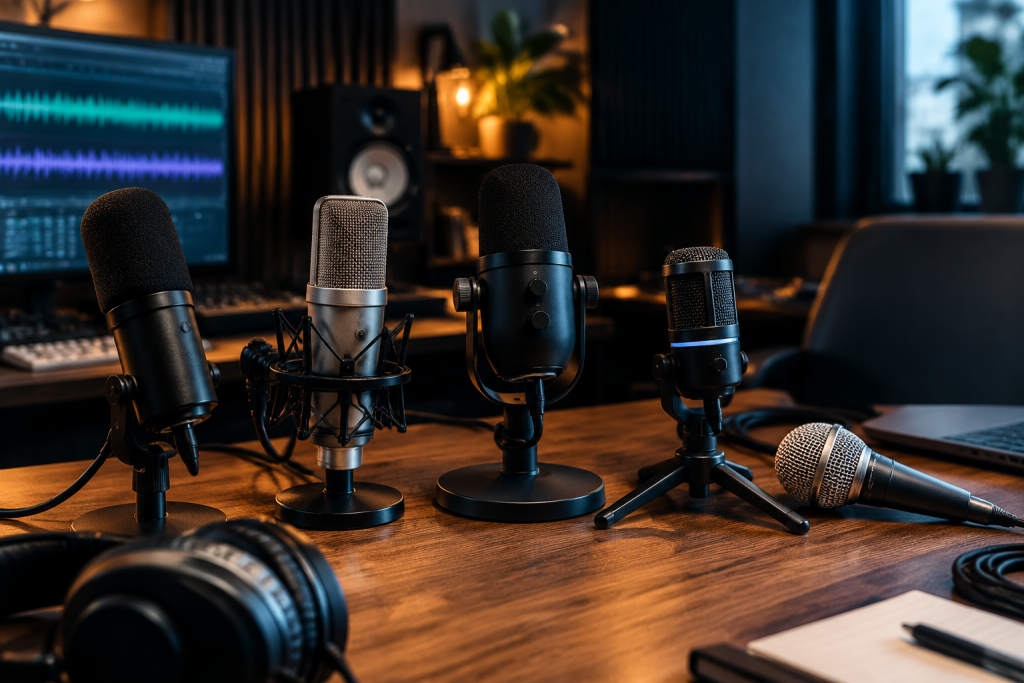
You can spend two weeks auditioning podcast mics and still get it wrong. Not because you picked a bad microphone, but because you picked it for the wrong room.
Here’s the thing nobody says loud enough: a $900 condenser will sound worse than a $70 dynamic if your space has a fridge humming in the next room and bare walls bouncing your voice around. Microphones don’t just capture you. They capture everything you failed to treat.
So before we get into specific picks, a quick framework. Then the recommendations.
Match the mic to the room, not the price tag
Most “best podcast microphone” lists rank models by how they sound in a treated studio. That’s not your bedroom, your closet, or the spare office with the hard floor.
Two specs actually matter for podcasting:
- Polar pattern. Cardioid picks up what’s in front and rejects what’s behind. Tight cardioid and supercardioid patterns are your friends in untreated rooms. Omnidirectional mics hear the whole room, which is a problem when the whole room is noisy.
- Type. Dynamic mics are rugged and forgiving, with less sensitivity to room reflections. Condensers are clean and detailed but pick up everything, including the neighbor’s dog.
One honest rule from engineers who do this for a living: put the biggest chunk of your budget into the microphone itself. A $500 mic into a $100 interface beats a $100 mic into a $500 interface almost every time. The mic shapes your raw sound. Everything downstream just processes what it’s handed.
Under $100: the workhorses
This tier is dominated by one mic, and it’s earned it.
Shure SM58 (around $99). Yes, it’s a stage vocal mic. It’s also a dynamic cardioid with a built-in pop filter, near-indestructible build quality, and a mid-forward character that cuts through a noisy room. Podcasters have used it for years. It’s not detailed in the way a condenser is, and you’ll want a decent preamp because it needs gain, but it will outlive your podcast.
If you want a cheaper entry, the Behringer XM8500 runs around $25. It’s an SM58-alike. It sounds thinner and the build is what you’d expect at that price, but for a first episode or a backup, it works.
The trade-off at this tier: you’ll spend more time on gain staging and EQ cleanup. That’s the cost of entry.
$100 to $300: the sweet spot
This is where most podcasters should live.
Shure SM7B (around $399). Slightly over this bracket, but it belongs in the conversation because it’s the de facto standard for spoken word. Dynamic, cardioid, heavy internal shielding, and a low-end rolloff switch that helps in a boomy room. The catch: it’s famously gain-hungry. You’ll need an interface with clean, high-gain preamps, or an inline preamp like a Cloudlifter. Budget for that.
Audio-Technica AT2040 (around $99). A dedicated podcast dynamic with a tight cardioid pattern and internal shock mounting. It’s designed for exactly this use case and needs less gain than the SM7B. Good first serious mic.
Rode PodMic (around $99). Similar brief to the AT2040. Dynamic, cardioid, built like a tank. It has a slightly scooped sound that flatters voices right out of the box.
For a condenser in this range, the Audio-Technica AT2020 (around $99) is the classic budget option. Detailed, clean, and very sensitive. That last part is the problem in untreated rooms. Treat it as a mic for a quiet, softly furnished space.
$300 to $700: pro-grade for one voice
You’re paying for lower noise floors, better off-axis rejection, and a sound that needs less fixing in post.
Shure SM7dB (around $499). Same mic as the SM7B but with a built-in preamp, which solves the gain problem entirely. If you’re running a modest interface and want the SM7 sound without buying extra gear, this is the move.
Electro-Voice RE20 (around $449). A large-diaphragm dynamic with a variable-D design that minimizes proximity effect. That means you can move around the mic without your low end jumping all over the place. Radio studios have used it for decades for good reason.
Heil PR-40 (around $370). Another broadcast workhorse. Tight cardioid, strong rear rejection, a slightly bright upper midrange that keeps voices intelligible.
At this tier, the honest advice: try before you buy. Shortlist five or six mics with genuinely different characters, not five condensers from five brands. A dynamic, a condenser, and something dark-sounding will teach you more about your voice in an hour than reading specs for a week. Book a studio, rent a couple, or find a shop that lets you test. Record the same paragraph on each and listen back on headphones and on phone speakers.
$700 and up: diminishing returns for most
Neumann, Sennheiser MKH series, high-end tube condensers. These are magnificent microphones. They are also unforgiving.
A $1,500 condenser in an untreated room will capture every reflection, every HVAC cycle, and every chair creak with startling fidelity. Unless your space is treated and quiet, spend the money on acoustic treatment first. You’ll hear a bigger improvement.
Where high-end mics genuinely earn their price: professional VO work, high-volume production, and situations where the room is already handled and the last 5% of detail matters.
Don’t forget the interface
The mic is half the chain. A few notes, because this trips people up.
For a solo podcaster, a 1 or 2 input interface is plenty. The Mackie Onyx Artist 1.2 runs around $89 and pairs a solid Onyx preamp with a bus-powered, portable design. It’s a clean, simple option, though the single input and lack of MIDI mean it won’t grow with a multi-mic setup.
The PreSonus AudioBox USB 96 sits around $100 with two combo inputs, MIDI I/O (rare at that price), and a copy of Studio One Artist. The preamps aren’t as refined as pricier units, but they’re perfectly usable.
Moving up, the Focusrite Scarlett 2i2 4th Gen is around $190. Two preamps, USB-C, 24-bit/96kHz, and a solid driver reputation.
If you’re on Windows, ASIO drivers are non-negotiable for low-latency monitoring. RME, MOTU, and Universal Audio have the best driver reputations, but you pay for them.
What actually matters
Buy a dynamic cardioid if your room isn’t treated. Buy a condenser only if it is.
Spend more on the mic than the interface. Test before you commit if you possibly can. And remember that a good mic in a bad room loses to a decent mic in a quiet one, every single time.
Get the room right, get the mic right, and the rest is just talking.